
By Danielly Favaretti
Founder, Dani Steel
2026-08-10
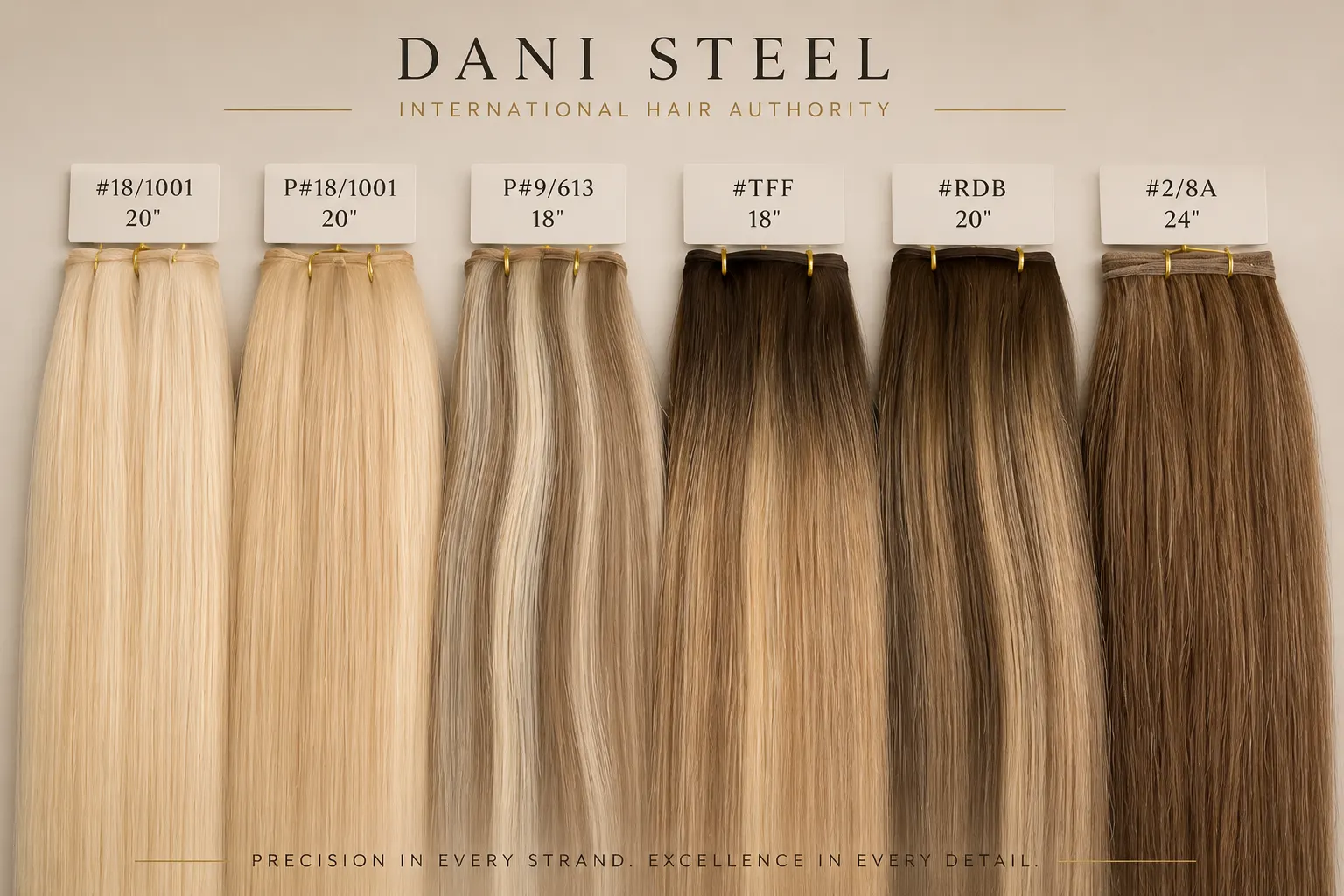
Two shades can sit next to each other on a chart, read as the same depth from a metre away, and behave completely differently once they are in someone's hair. The difference is not the colour. It is whether the colour is one thing or several.
Counted across the governed library, that split is almost even: 32 shades are solid and 28 are constructed. Close to half of what a stylist selects from is architecture rather than tone.
A solid shade is one decision
A solid shade carries a single value from root to end. It is the simplest thing to match and the least forgiving thing to install badly, because there is nothing in the colour to disguise a line where old hair meets new.
Thirty-two of the sixty governed shades work this way, and they are the reason the Core collection is the largest at thirty.
A constructed shade is several decisions in sequence
Constructed colour puts more than one value into the same length of hair, positioned deliberately. In the governed library it takes three forms, and they are separate collections rather than variations on one idea.
Constructed shades in the governed library
| Construction | Shades | What is being built |
|---|---|---|
| Balayage | 15 | Lightness placed toward the mid-lengths and ends, deeper at the root |
| Fusion | 7 | Two values blended through the length rather than zoned |
| Shadow root | 6 | A deliberately deeper root reading into a lighter body |
Balayage alone is fifteen shades — a quarter of the entire library, and more than any single family of solid tone.
Why this changes a match
When the colour is constructed, matching at one point on the strand is not matching. A balayage and a solid shade can agree exactly at the mid-length and diverge at both ends, which is precisely where an extension meets the client's own hair.
Dani Steel observation, stated as such: this follows from how the shades are built, not from a controlled study of matching outcomes.
What the library does not tell you
Depth is recorded as zero for all sixty shades and shade-to-shade similarity is empty for all sixty. Nothing here ranks shades by depth or names a nearest neighbour, because the governed data does not support it. Any such claim would be invention.
Where to look next
The Color Experience shows every shade photographed from the front, on model and from behind. The balayage and shadow-root family pages group the constructions described above. If the question is which shade to choose rather than how a shade is built, the colour-matching guide answers that directly.