
By Danielly Favaretti
Founder, Dani Steel
2026-08-10
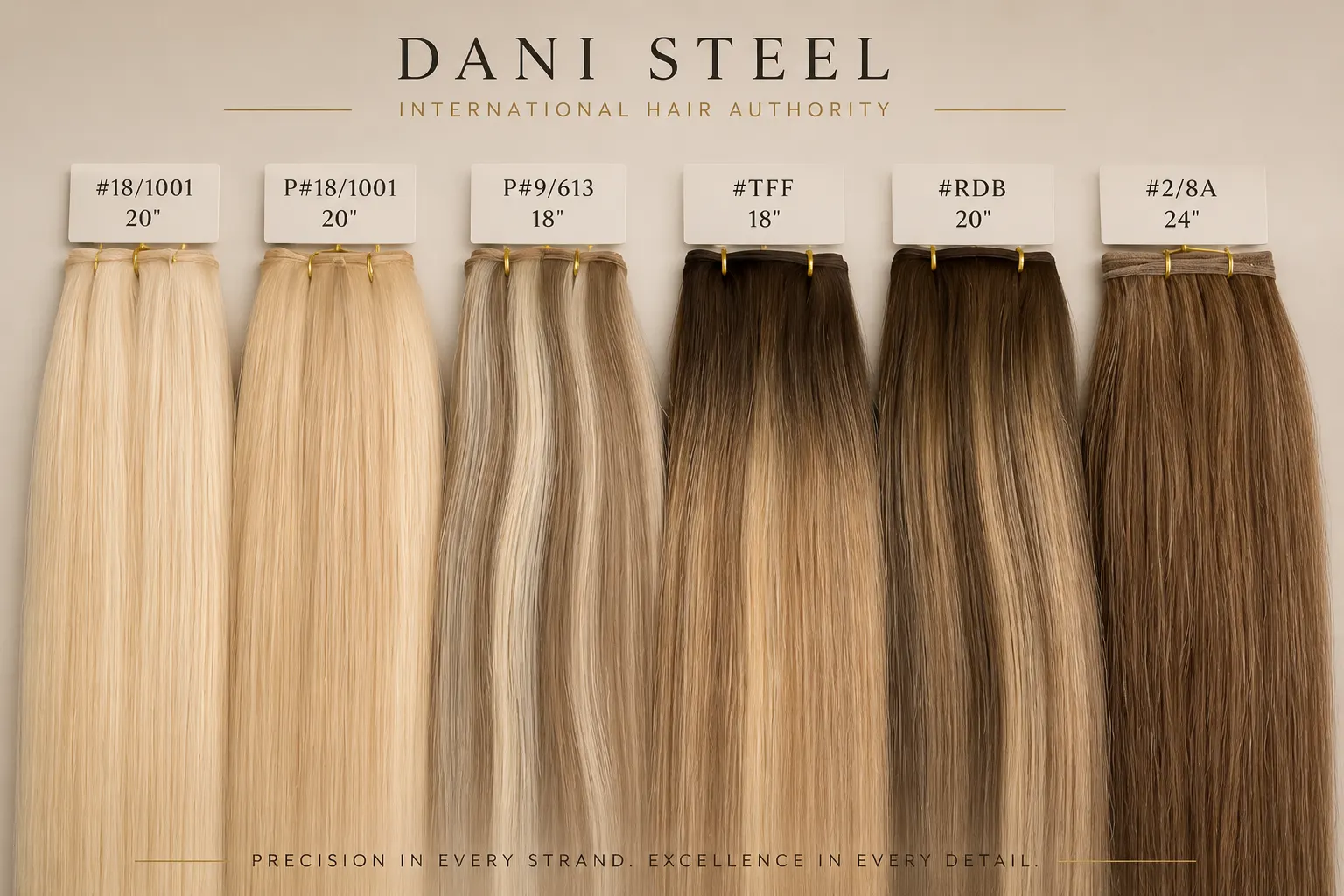
Most shade charts are marketing surfaces. They are built to be browsed, not counted. This report counts one: the sixty shades that make up Dani Steel's governed commercial library, examined as a structure rather than as a menu.
The findings below are arithmetic on a catalogue we maintain. That is the whole claim — and the limits of that claim are stated as plainly as the numbers.
What was analysed
Every shade in the governed library at the time of writing: sixty records, each carrying a canonical code, a canonical name, a collection, a family, and three categories of photographic documentation. All sixty are marked OFFICIAL and classified. None is provisional.
Methodology
This is first-party catalogue analysis. Every figure is a count or a proportion taken directly from the governed colour records that drive the storefront — the same records that determine which shades can be configured and sold.
It is not consumer research, market-share research, sales research, or scientific population sampling. No customer, no order and no preference signal enters any figure below. A catalogue describes what a company chose to make; it does not describe what anyone bought.
Three roles stay separate here. The DATA is Dani Steel's governed colour library. The ANALYSIS, and the editorial responsibility for how it is framed, are mine. Dani Steel is the publisher. Signing this report does not turn catalogue arithmetic into personal opinion — it means someone is accountable for the framing.
Collection distribution
The library is organised into five collections, and they are not evenly weighted. Half the library sits in Core; the remaining half is distributed across four construction-led collections.
Governed collections, n = 60
| Collection | Shades | Share |
|---|---|---|
| Core | 30 | 50.0% |
| Balayage | 15 | 25.0% |
| Fusion | 7 | 11.7% |
| Shadow | 6 | 10.0% |
| Fashion | 2 | 3.3% |
The shape is worth pausing on. A library that was simply a colour range would concentrate in one place. This one splits evenly between a foundational half and a constructed half, and the constructed half is itself divided three ways.
Solid and constructed colour
Classifying every shade by whether its colour is a single tone or an architecture of more than one produces the sharpest finding in the dataset.
Colour architecture, n = 60
| Architecture | Shades | Share |
|---|---|---|
| Solid | 32 | 53.3% |
| Constructed (balayage, fusion, shadow root) | 28 | 46.7% |
Twenty-eight of sixty governed shades — 46.7% — use a constructed colour architecture rather than a single tone. Close to half the library is built rather than dyed to one value.
This is a statement about what the library contains. It is not a statement about demand: no sales or preference data exists in the governed dataset, and none is implied here.
Family distribution
Beneath the collections sit twelve families, and their spread is deliberately uneven — a family is a way of grouping shades that behave alike, not a quota to fill.
Governed families, n = 60
| Family | Shades |
|---|---|
| Balayage | 15 |
| Fusion | 7 |
| Shadow root | 6 |
| Platinum | 6 |
| Honey | 5 |
| Blonde | 5 |
| Brunette | 5 |
| Caramel | 3 |
| Black | 2 |
| Beige | 2 |
| Espresso | 2 |
| Copper | 2 |
Balayage alone accounts for a quarter of the library. At the other end, four families carry two shades each — enough to be a real option, not enough to be a range.
Visual documentation coverage
Every shade in the library is photographed three ways, and the coverage is complete.
Photographic coverage, n = 60
| Documentation type | Covered | Coverage |
|---|---|---|
| Palette | 60 | 100% |
| On model | 60 | 100% |
| Rear / behind | 60 | 100% |
A hundred per cent on all three is unusual, and it is the part of this dataset most directly useful to a professional: a shade you cannot see from behind is a shade you cannot honestly recommend for a full head.
Naming and taxonomy evolution
Twenty-nine of the sixty shades — 48.3% — carry a legacy name alongside their canonical one, and all sixty carry inbound aliases. The library has been renamed at least once, and the old vocabulary was retained rather than discarded.
That retention has a practical consequence: a stylist who learned a shade under its previous name can still find it.
What this report does not measure
The governed dataset does not currently support quantitative conclusions about any of the following, and this report makes none.
Not measured, and why
| Dimension | State in the governed data |
|---|---|
| Depth / level | Recorded as 0 for all 60 shades — no depth rank exists |
| Nearest-shade relationships | The similarity field is empty for all 60 shades |
| Undertone | Not a governed field |
| Popularity | Not governed |
| Sales ranking | Not governed |
| Customer preference | Not governed |
These are gaps in the dataset, not in the shades. Depth and undertone are real properties of hair colour; they are simply not yet recorded here in a form that could be counted. Any figure anyone publishes about them from this library would be invention.
Implications for professional colour matching
Two findings carry directly into a consultation chair. The first is that nearly half the library is constructed colour, so a match is often a match of architecture rather than of a single tone — a solid shade and a balayage can read as the same colour at the mid-lengths and diverge completely at the root and ends.
The second is the complete rear documentation. Matching against a front-facing swatch alone is matching against the half of the head a client cannot see and everyone else can.
Dani Steel observation, stated as such: these follow from the structure of the library, not from a controlled study of matching outcomes.
Methodological limitations
The sample is one company's library at one moment. It is complete for that library and generalises to nothing else. The classifications are Dani Steel's own — a shade is a balayage because the library governs it as one, which is a commercial and technical judgement rather than a measurement.
Proportions are reported to one decimal place on a base of sixty; a single reclassified shade moves any share by 1.7 points.
Conclusion
A sixty-shade professional library turns out to be two libraries of roughly equal size: thirty-two solid shades and twenty-eight built ones, each fully documented from three angles. What it is not yet is a measured one — depth, undertone and shade relationships remain unrecorded, and until they are recorded, nobody should publish numbers about them.